Traditional PRDs don't work for AI agents
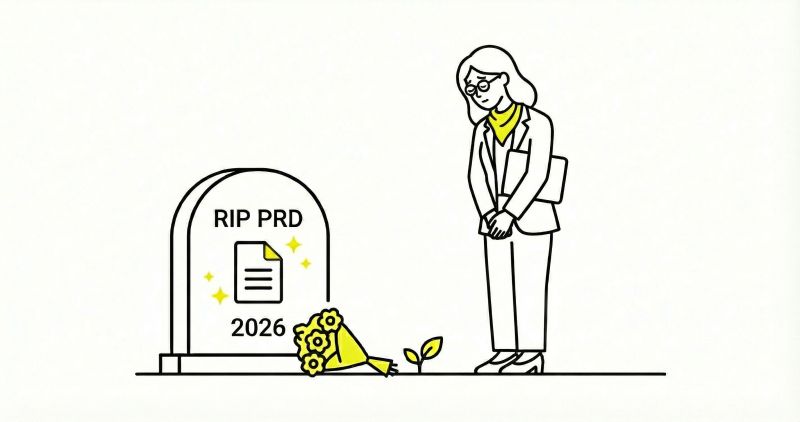


Traditional PRDs weren't designed for building AI Agents - Here's what we need instead
The Product Requirements Document is the starting point for many software developments. It sets out the purpose, target audience, features, performance targets and other key aspects for the software. The PRD is an essential tool to align understanding and expectations across business users, developers and other stakeholders. It's a core skillset of any Product Manager or Product Owner, in Agile and other development methodologies.
Over the last 10 years, we've written dozens of PRDs. So when it came to building AI agents, the PRD was the natural starting point. But we faced a problem. The traditional PRD and its so far rock-solid structure was just not effective for AI agents.
The problem is, PRDs were designed for deterministic software where you can specify exact inputs and outputs. They did that job well. With agents, you're not specifying what the system does. You're specifying how it should behave, when it should stop, and what it's allowed to decide on its own. This is new territory and we need new documentation to match.
There are two main gaps that are important to highlight:
1. The hidden costs problem
Traditional business cases focus on efficiency gains and time saved. But agents come with costs that weren't a factor before: evaluation infrastructure, observability and monitoring, governance and guardrails, human oversight mechanisms, ongoing maintenance as models change. If you're not factoring these in from the start, you're setting yourself up for a nasty surprise later.
2. The behaviour specification problem
User stories work extremely well for features. "As a user, I want to reset my password so that I can regain access to my account." Clear. Testable. The "so that" captures the value. But how do you write a user story for an agent that needs to know when to escalate, when to ask clarifying questions, when to refuse a request, and when to stop entirely? Agents still need to deliver value. You still need to determine the MVP. But we need new ways to capture it.
What we've learned building agents
After building many single and multi-agent systems, we've found that even AI-specific PRD templates don't fully address what is needed to ensure AI agents perform as desired. In particular, core aspects of AI agents aren't covered by traditional PRDs, because they aren't a factor in traditional software, including:
behaviour boundaries
decision authority levels
stop rules
evaluation criteria (termed evals)
human-in-the-loop architecture
observability
governance integration
AI-specific security concerns (like prompt injections)
orchestration (in multi-agent systems)
separation of controls/handoff between agents and code
Evals in particular are critical. Hamel Husain and Shreya Shankar's course on AI agent evals provides invaluable content. But where does evaluation criteria live in traditional documentation? It wasn't included because it wasn't needed (testing was typically included, but AI agent evaluation is quite different than traditional software testing).
Serpin's solution: the Agent Requirements Document (ARD). The ARD is the AI agent blueprint, giving Product Mangers and stakeholders a clear roadmap to capture everything needed to develop robust, high-value AI agents. Together with associated training, Serpin is helping clients build better AI agents.
Traditional PRDs weren't designed for building AI Agents - Here's what we need instead
The Product Requirements Document is the starting point for many software developments. It sets out the purpose, target audience, features, performance targets and other key aspects for the software. The PRD is an essential tool to align understanding and expectations across business users, developers and other stakeholders. It's a core skillset of any Product Manager or Product Owner, in Agile and other development methodologies.
Over the last 10 years, we've written dozens of PRDs. So when it came to building AI agents, the PRD was the natural starting point. But we faced a problem. The traditional PRD and its so far rock-solid structure was just not effective for AI agents.
The problem is, PRDs were designed for deterministic software where you can specify exact inputs and outputs. They did that job well. With agents, you're not specifying what the system does. You're specifying how it should behave, when it should stop, and what it's allowed to decide on its own. This is new territory and we need new documentation to match.
There are two main gaps that are important to highlight:
1. The hidden costs problem
Traditional business cases focus on efficiency gains and time saved. But agents come with costs that weren't a factor before: evaluation infrastructure, observability and monitoring, governance and guardrails, human oversight mechanisms, ongoing maintenance as models change. If you're not factoring these in from the start, you're setting yourself up for a nasty surprise later.
2. The behaviour specification problem
User stories work extremely well for features. "As a user, I want to reset my password so that I can regain access to my account." Clear. Testable. The "so that" captures the value. But how do you write a user story for an agent that needs to know when to escalate, when to ask clarifying questions, when to refuse a request, and when to stop entirely? Agents still need to deliver value. You still need to determine the MVP. But we need new ways to capture it.
What we've learned building agents
After building many single and multi-agent systems, we've found that even AI-specific PRD templates don't fully address what is needed to ensure AI agents perform as desired. In particular, core aspects of AI agents aren't covered by traditional PRDs, because they aren't a factor in traditional software, including:
behaviour boundaries
decision authority levels
stop rules
evaluation criteria (termed evals)
human-in-the-loop architecture
observability
governance integration
AI-specific security concerns (like prompt injections)
orchestration (in multi-agent systems)
separation of controls/handoff between agents and code
Evals in particular are critical. Hamel Husain and Shreya Shankar's course on AI agent evals provides invaluable content. But where does evaluation criteria live in traditional documentation? It wasn't included because it wasn't needed (testing was typically included, but AI agent evaluation is quite different than traditional software testing).
Serpin's solution: the Agent Requirements Document (ARD). The ARD is the AI agent blueprint, giving Product Mangers and stakeholders a clear roadmap to capture everything needed to develop robust, high-value AI agents. Together with associated training, Serpin is helping clients build better AI agents.
Category
Insights
Insights
Insights
Written by

Julia Druck
Latest insights and trends
Let's have a conversation.
No pressure. No lengthy pitch deck. Just a straightforward discussion about where you are with AI and whether we can help.
If we're not the right fit, we'll tell you. If you're not ready, we'll say so. Better to find that out in a 30-minute call than after signing a contract.

Let's have a conversation.
No pressure. No lengthy pitch deck. Just a straightforward discussion about where you are with AI and whether we can help.
If we're not the right fit, we'll tell you. If you're not ready, we'll say so. Better to find that out in a 30-minute call than after signing a contract.

Let's have a conversation.
No pressure. No lengthy pitch deck. Just a straightforward discussion about where you are with AI and whether we can help.
If we're not the right fit, we'll tell you. If you're not ready, we'll say so. Better to find that out in a 30-minute call than after signing a contract.