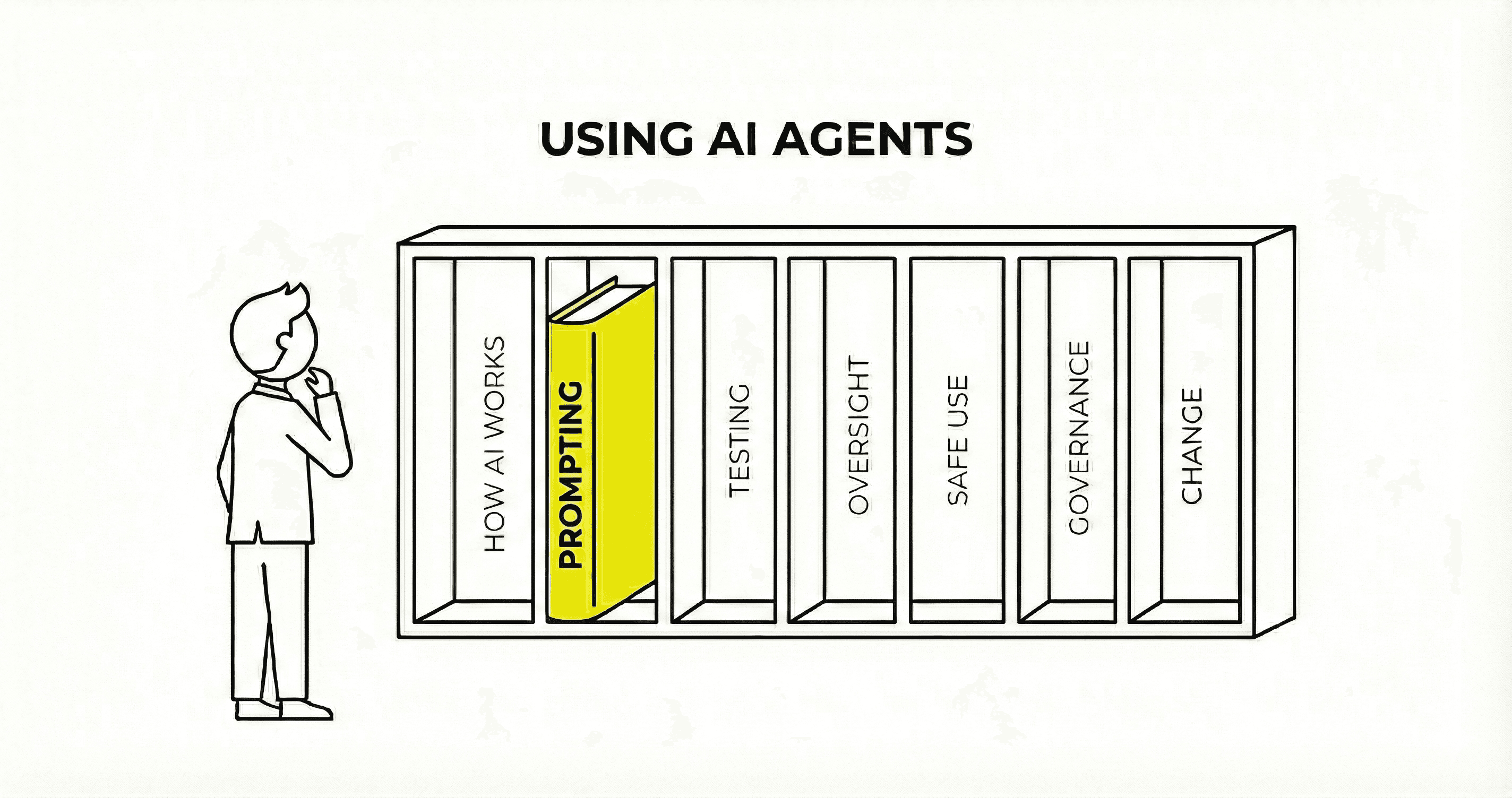
The Executive Guide to AI Agents



The AI revolution is creating unprecedented opportunities for organisations ready to seize them. While many struggle to translate pilots into value, those with the right approach achieve remarkable returns. This guide reveals the patterns that separate success from struggle, drawing from proven implementations and the latest advances in AI agents and enterprise deployment.
Executive Summary
AI agents now autonomously handle complex workflows, transforming how businesses operate across industries
Gartner predicts more than 80% of enterprises will have used generative AI APIs or deployed GenAI-enabled applications by 2026, up from less than 5% in 2023, signalling massive transformation ahead
Success requires systematic approaches to opportunity identification, organisational infrastructure, and production engineering
Security and governance, properly implemented, accelerate rather than constrain AI deployment
Organisations building shared AI platforms and breaking down silos achieve economies of scale and compound learning benefits
The strategic window remains open for organisations ready to move beyond experimentation to value creation
Introduction
We're witnessing the early stages of a business transformation as significant as the rise of the internet. As Microsoft states in their 2024 annual report: "We have entered a new age of AI that will fundamentally transform productivity for every individual, organization, and industry on earth."[1] AI agents now autonomously plan, execute, and adapt to complex business challenges. AI systems process and generate insights from vast amounts of unstructured data, recognising patterns and making predictions that surpass human capability. The capabilities that seemed like science fiction two years ago are delivering real value today.
Yet a paradox persists. Gartner research shows more than 80% of enterprises expect to deploy generative AI in production by 2026[2]. The same analysts predict that at least 30% of generative AI projects will be abandoned after proof of concept by end of 2025, due to poor data quality, inadequate risk controls, escalating costs or unclear business value. MIT research reveals 95% of generative AI pilots fail to reach production[3]. This gap between expectation and reality has a clear explanation: success with AI isn't about having access to the latest technology. It's about having a systematic approach to identifying the right opportunities, building the necessary foundations, creating environments to support effective and safe experimentation, iterating efficiently to refine the best ideas, and scaling what works.
The Strategic Imperative
Boards and CEOs face a fundamental question: Is AI an efficiency tool or a source of competitive advantage? The 2025 Stanford AI Index reveals capabilities advancing on technical benchmarks by 18.8 to 67.3 percentage points year-over-year, with inference costs dropping 280-fold, making AI increasingly accessible and powerful[4]. These advances are translating into real operational improvements for prepared organisations.
The strategic consideration is straightforward. While you evaluate options, competitors deploy agents that learn from every interaction, scale without linear cost increases, and operate continuously. Each month of delay widens the capability gap. The window for establishing AI leadership is measured in quarters, not years.
The difference between organisations achieving these returns and those stuck in pilot purgatory comes down to strategic choices and execution excellence. Organisations must match boardroom priorities to technical realities, navigate change management complexities while engineering for scale, and build governance frameworks that enable rather than constrain innovation.
Understanding the AI Opportunity
The Revolution Is Real and Accelerating
The 2025 Stanford AI Index reveals capabilities advancing faster than ever before[4]. Performance on complex reasoning tasks, code generation, and multimodal understanding continues to improve dramatically. More importantly, these advances are translating into business value for prepared organisations.
Financial services firms using AI report significant returns on investment. According to Deloitte's research on generative AI in financial services, 47% of AI pioneers estimate that ROI from their advanced generative AI initiatives exceeds their expectations, compared with only 17% of followers[5]. Manufacturing companies are achieving dramatic efficiency improvements. World Economic Forum data shows Lighthouse factories using AI have reduced downtime by more than 50%, increased labour productivity by an average of 50%, and accelerated new product development cycles by 30-67%[6]. Customer service operations handle complex queries with AI agents that understand context, emotion, and intent, delivering satisfaction scores that exceed human-only teams.
The emergence of AI agents represents a particular breakthrough. Unlike simple chatbots or rule-based automation, agents autonomously break down complex tasks, execute multi-step processes, and adapt based on outcomes. They collaborate with humans and other agents, orchestrating workflows that previously required entire teams. This isn't incremental improvement; it's fundamental transformation of how work gets done.
Why Success Remains Elusive for Most
Despite compelling evidence of AI's value, most organisations struggle to capture it. Implementation experience reveals five critical factors that determine success or failure:
1. Organisations are Still Learning How to Evaluate AI Opportunities
Many organisations pursue AI without systematic evaluation of where it adds genuine value. Success requires structured approaches to opportunity discovery. Leading organisations use value mapping exercises that analyse every customer touchpoint, operational process, and decision point to identify AI potential. They employ techniques like process mining (automated analysis of system logs to understand actual workflows) and value stream mapping to uncover hidden inefficiencies.
The assessment process examines three critical dimensions: First, data availability and quality, using automated data profiling tools to understand completeness, accuracy, and accessibility. Second, technical feasibility, evaluating whether current AI capabilities can address the identified opportunity with tools like proof-of-concept scorecards and capability maturity matrices. Third, business impact, quantifying potential value through techniques like Monte Carlo simulation for risk assessment and sensitivity analysis for ROI projections.
This systematic approach reveals non-obvious opportunities. A financial services firm discovered their highest-value AI opportunity wasn't in trading algorithms but in automating compliance documentation, saving thousands of hours annually while reducing regulatory risk.
2. Firms Need Different Organisational and Technical Infrastructure to Run AI at Scale
Success requires more than hiring data scientists. It demands comprehensive organisational infrastructure that enables AI at scale. This includes technical components like shared agent libraries, model repositories, and MLOps platforms. But equally important are the human and organisational elements.
Leading organisations establish AI Centres of Excellence that break down silos, enabling AI agents to synthesise data from across the enterprise. For example, agents gather customer interaction data from service departments, combine it with purchase history from sales systems, and correlate it with product usage data from operations, creating insights impossible within departmental boundaries. These centres provide coordination across the organisation to prioritise investments, capture winning ideas, support secure and effective scaling, and ensure common standards of security, governance and data stewardship.
Common vocabulary between business and technical teams proves essential. When executives understand terms like "inference cost" (the computational expense of running AI models) and "model drift" (degradation of AI performance over time), and technical teams grasp concepts like "customer lifetime value" and "risk-adjusted returns," AI initiatives move faster and deliver better outcomes.
3. Change Management is Key to Sustainable AI Success
Technology without adoption fails. Technically brilliant AI solutions get abandoned when organisations neglect the human side of transformation. Successful AI deployment requires comprehensive change management that engages stakeholders, addresses their concerns, builds capability, and demonstrates value.
This starts with transparent communication about AI's role: augmenting human capability, not replacing it. It continues with practical training that helps employees work effectively alongside AI agents. It culminates in measuring and improving adoption, using feedback loops to refine both technology and processes.
4. Firms Need Efficient AI-Specific Security and Governance Systems
Too often, security and governance become afterthoughts that derail AI initiatives just as they're ready to scale. Successful organisations engage risk and compliance teams from day one, building governance into AI systems rather than bolting it on later.
This means establishing guardrails for agent behaviour, ensuring they operate within defined parameters. It means validating models for bias, implementing monitoring for drift, tracking performance degradation. It means choosing appropriate human oversight models, whether human-in-the-loop (where humans approve critical decisions) or human-on-the-loop (where humans monitor and can intervene when needed).
Modern security approaches include penetration testing for AI systems, prompt injection prevention (stopping malicious inputs from manipulating AI behaviour), data poisoning detection (identifying attempts to corrupt training data), and adversarial robustness testing. Tools like Credo AI, Weights & Biases, and custom monitoring solutions make this practical. But tools alone aren't enough. You need frameworks that translate principles into operational practice, governance boards that can make quick decisions, and processes that evolve with your AI maturity.
5. Organisations Struggle with the Prototype-to-Production Gap
The graveyard of AI initiatives is filled with impressive prototypes that couldn't scale. The non-deterministic nature of AI models (where the same input can produce different outputs) creates challenges that don't exist in traditional software. Costs can explode without proper controls. Performance can degrade under load. Agents can behave unpredictably when deployed widely.
Success requires engineering for scale from the start. This means implementing robust testing frameworks including unit tests for individual components, integration tests for system interactions, and end-to-end tests for complete workflows. Cost control mechanisms include token limits (restricting the amount of text processed), caching strategies to avoid redundant processing, and model selection algorithms that choose the most cost-effective model for each task. Performance monitoring tracks latency, throughput, and accuracy metrics in real-time. Failover mechanisms ensure system resilience when individual components fail.
Strategic Questions for Leadership
Boards overseeing AI transformation need frameworks that connect technical capability to business fundamentals:
"What creates our sustainable advantage?" Generic AI delivers generic results. Competitive advantage comes from proprietary data, unique processes, or domain expertise that others can't replicate. Your customer interaction history, proprietary research data, or specialised decision-making frameworks become differentiators when properly structured for AI use.
"How might AI reshape our business model?" Beyond operational improvement, AI enables new business models. Financial services firms shift from reactive fraud detection to predictive risk prevention. Professional services firms productise expertise through AI agents that deliver consulting insights at scale. Retail companies move from product sales to personalised experience platforms. Leadership must consider not just operational enhancement but business model evolution.
"What are the implications of success?" Successful AI deployment brings organisational challenges. Changes in resourcing needs across different areas. New skill requirements. Different risk profiles. Evolved customer expectations. Strategic planning must anticipate these transitions and prepare appropriate support structures.
"How do we value compound benefits?" Traditional ROI calculations miss AI's network effects. Agents built for one function deliver value in other parts of the organisation. Data prepared for one initiative enables others. Capabilities developed in one area transfer across the organisation. Valuation frameworks need to capture these compound benefits.
Building Your Strategic Framework
From Scattered Experiments to Strategic Portfolio
MIT research reveals that organisations achieving superior AI returns don't do more initiatives; they do fewer, better-chosen ones aligned to clear strategy[3]. They manage AI as a portfolio, balancing different types of investment across time horizons and risk levels.
Consider structuring your AI portfolio across three horizons:
Horizon 1: Operational Excellence (40-50% of effort) Focus on proven AI applications that enhance existing processes. Deploy agents for customer service automation, document processing, and basic analytics. These should deliver returns quickly while building organisational confidence. The technology risk is low, the level of change management is manageable, and the value case is clear.
Horizon 2: Strategic Transformation (35-40% of effort) Invest in AI that transforms core business processes. Multi-agent systems that handle complex workflows across departments. Advanced personalisation engines that fundamentally change customer experience. Predictive systems that shift you from reactive to proactive operations. These initiatives require more organisational change but offer sustainable competitive advantage.
Horizon 3: Business Model Innovation (10-20% of effort) Reserve resources for breakthrough opportunities. AI-native products that couldn't exist without artificial intelligence. Autonomous agent platforms that might fundamentally change your industry. External monetisation of your AI capabilities. These are your options on the future, where learning matters more than immediate returns.
This portfolio approach ensures you build momentum through quick wins while positioning for long-term transformation.
Five Strategic Enablers for AI Success
Successful AI transformation requires five foundational enablers. Understanding these components and how they interconnect determines whether initiatives deliver value or join the graveyard of failed pilots.
1. Transform Your Unique Data into Strategic AI Advantage
Your proprietary data and domain knowledge represent sustainable competitive advantage in the AI era. The challenge is structuring this knowledge so AI can leverage it effectively.
This goes beyond traditional data warehousing. It means creating reusable AI components that capture your unique insights. Customer intelligence modules that understand your specific buyer patterns. Risk scoring engines that embody your credit expertise. Quality prediction agents trained on your operational data.
Practical implementation requires three elements. First, establish data catalogues that document what data exists, where it resides, who owns it, and what quality standards apply. Tools like Collibra, Alation, or AWS Glue Data Catalog automate discovery and classification. Second, implement feature stores (centralised repositories of processed data features) using platforms like Tecton, Feast, or Databricks Feature Store. These ensure consistent data preparation across all AI initiatives. Third, create knowledge graphs that capture relationships between entities, enabling AI to reason about your business domain using tools like Neo4j, Amazon Neptune, or Google's Knowledge Graph API.
2. Build Infrastructure for Rapid AI Scaling and Compound AI Learning
Successful AI transformation requires organisational systems that enable scale and compound learning:
Shared Agent Libraries: Instead of each department building separate AI solutions, create shared libraries of agents that any team can deploy. A customer insight agent developed for marketing becomes valuable for product development and customer service. Implementation requires standardised interfaces (APIs that allow different systems to communicate), version control systems (tracking changes and enabling rollbacks), and deployment frameworks like Kubernetes or Docker Swarm.
Model Governance Frameworks: Establish clear processes for model development, testing, deployment, and monitoring. Define roles and responsibilities using frameworks like RACI matrices (Responsible, Accountable, Consulted, Informed). Create approval workflows that balance speed with safety using tools like Apache Airflow or Prefect for orchestration.
Automated Model Operations (MLOps): AI models degrade over time as business conditions change. Customer behaviour shifts, market dynamics evolve, regulatory requirements update. Without systematic monitoring and retraining, high-performing AI becomes unreliable.
Leading organisations implement automated pipelines using platforms like MLflow, Kubeflow, or Amazon SageMaker. These continuously monitor agent performance through metrics like prediction accuracy, response time, and business KPI impact. They detect when models drift from expected behaviour using statistical tests like Kolmogorov-Smirnov or Population Stability Index. When performance drops below thresholds, they automatically trigger retraining using fresh data, validate new models against test sets, and deploy updates with blue-green deployment strategies (running old and new versions in parallel before switching).
Cross-Functional Platforms: Build platforms that break down silos, enabling agents to access data and execute workflows across departments. This requires enterprise service buses (ESB) or modern alternatives like event streaming platforms (Apache Kafka, Amazon Kinesis) that enable real-time data flow. API gateways (Kong, Apigee) provide secure, managed access to services across the organisation.
Learning Mechanisms: Ensure insights from one AI initiative improve others. Implement knowledge management systems that capture lessons learned, best practices, and reusable components. Create communities of practice where teams share experiences. Establish metrics dashboards using tools like Tableau, PowerBI, or Grafana that make AI performance visible across the organisation.
3. Embed Trust and Confidence Through AI-First Security and Governance
Properly implemented security and governance accelerate AI deployment rather than constraining it. They build trust, reduce rework, and prevent costly failures.
Modern frameworks like Google's Secure AI Framework (SAIF) and NIST's AI Risk Management Framework provide structured approaches[7]. Key components include:
Threat Modelling for AI: Identify potential attack vectors specific to AI systems. This includes prompt injection attacks (malicious inputs designed to manipulate AI behaviour), data poisoning (corrupting training data to create backdoors), model extraction (stealing proprietary models through repeated queries), and adversarial examples (inputs designed to fool AI systems). Tools like Microsoft's Counterfit and IBM's Adversarial Robustness Toolbox help identify vulnerabilities.
Continuous Validation: Implement automated testing for bias using tools like Fairlearn or AI Fairness 360. Monitor for drift using platforms like Evidently AI or WhyLabs. Track performance degradation with custom metrics relevant to your business domain. Set up alerting systems that notify teams when models behave unexpectedly.
Governance Frameworks: Establish clear policies for AI development and deployment. Define acceptable use policies, data handling requirements, and decision-making boundaries. Create ethics review boards that evaluate high-risk applications. Implement audit trails that track all AI decisions for compliance and debugging.
4. Lead with AI-Native Thinking
Leaders driving successful AI transformation demonstrate consistent approaches that set them apart from traditional technology adoption patterns.
Successful leaders establish AI as an enterprise priority with board oversight and senior accountability. This ensures AI transformation receives appropriate attention and resources rather than being relegated to departmental initiatives. AI steering committees include representation from business, technology, risk, and compliance functions.
Strategic funding means concentrating resources on initiatives with clear strategic value rather than spreading investment thinly across numerous experiments. Separate innovation budgets allow for experimentation without compromising operational stability.
Business outcomes drive every decision. Success metrics tie directly to commercial results: customer acquisition costs, service quality scores, time to market, revenue per customer. Initiatives that don't deliver measurable value are refined or discontinued through stage-gate processes where initiatives must demonstrate value before receiving additional funding.
Innovation thrives when teams can experiment, learn from outcomes, and share insights openly. This includes establishing innovation labs, hosting hackathons, creating safe spaces for failure, and celebrating learning regardless of outcome. Knowledge sharing platforms and regular show-and-tell sessions enable teams to demonstrate progress and share lessons.
5. Engineer for AI's Unique Demands
The journey from promising prototype to production deployment requires engineering excellence that addresses AI's unique challenges:
Managing AI Economics at Scale: Implement tiered model deployment where simple queries use lightweight models while complex problems engage more powerful (and expensive) systems. Use caching strategies to avoid reprocessing identical requests. Implement request batching to improve throughput. Monitor and optimise token usage (the units of text processed by language models) to control costs.
Engineering for AI Performance: Choose the right architecture to balance cost, speed, and responsiveness. Select cloud, on-premise, or hybrid deployments depending on your policies, data sensitivity, and resources. Implement asynchronous processing for non-real-time tasks. Use edge deployment (running models closer to users) to reduce latency. Optimise model size and efficiency using techniques like quantisation (reducing numerical precision) and pruning (removing unnecessary components) without significantly impacting accuracy.
Building Resilience and Reliability: Implement circuit breakers that prevent cascading failures when AI services become unavailable. Design fallback mechanisms that provide degraded but functional service when AI components fail. Create comprehensive monitoring that tracks not just technical metrics but business outcomes. Implement canary deployments where new models are tested with small user groups before full rollout.
The Journey from Strategy to Scale
While understanding the enablers is essential, execution requires a systematic journey. Here's how leading organisations progress from initial strategy to scaled deployment, with specific actions at each stage.
Stage 1: Mapping Your AI Opportunity Landscape
The foundation stage establishes the groundwork for successful AI transformation. This begins with comprehensive opportunity assessment using structured methodologies:
AI Value Discovery Sessions: Facilitate sessions with business stakeholders using techniques like Design Thinking and Value Stream Mapping. Document every customer interaction, operational process, and decision point. Use process mining tools like Celonis or ProcessGold to analyse actual workflows from system logs, revealing inefficiencies invisible to manual observation.
Assess Data for AI Readiness: Conduct systematic evaluation of data assets using automated profiling tools. Assess data quality across six dimensions: completeness, consistency, accuracy, timeliness, validity, and uniqueness. Tools like Great Expectations or Deequ automate quality checks. Create data quality scorecards that quantify readiness for AI initiatives.
Find Your Unique Data Advantage: Evaluate what proprietary data or domain expertise creates sustainable competitive advantage. Consider factors including: strategic importance (is this a differentiator or commodity?), available solutions (what exists in the market?), integration complexity (how difficult to incorporate?), total cost of ownership (including licenses, maintenance, and training), and capability development (what skills does your team gain?). Document decisions in a decision matrix that makes trade-offs explicit.
Stakeholder Alignment: Create compelling narratives that connect AI initiatives to business objectives. Develop business cases that articulate value in terms relevant to each stakeholder group: revenue growth, cost reduction, risk mitigation, customer satisfaction. Use visualisation tools to make abstract AI concepts tangible. Establish success metrics that matter to each stakeholder group.
Stage 2: Building AI-Ready Infrastructure
With strategy defined, organisations must prepare their infrastructure, governance, and teams:
Create AI Centres of Excellence: Cross-functional teams break down silos by including representatives from IT, business units, risk, compliance, and HR. Clear role definition ensures everyone knows who approves initiatives, who provides technical guidance, who ensures compliance, and who manages change. Regular cadences for review and decision-making keep momentum while maintaining oversight.
Build Technical Foundations: Deploy core platforms that all AI initiatives can leverage. Model registries like MLflow or Weights & Biases track all models, their versions, and performance. Feature stores ensure consistent data preparation across teams. Experiment tracking systems document what was tried and what was learned. Deployment platforms like Kubernetes or SageMaker standardise how models reach production, reducing friction and accelerating time to value.
Develop Governance Frameworks: Effective AI governance integrates with existing risk and compliance functions while addressing AI-specific challenges. The EU AI Act requires systematic risk assessment for high-risk AI applications, with documentation requirements that vary by use case. The US Executive Order on AI emphasises safety testing and trustworthy AI development. The UK's principles-based approach focuses on innovation with appropriate safeguards.
Organisations must create policies that enable innovation while managing these regulatory requirements. This means establishing approval processes that match risk levels, where low-risk initiatives can proceed quickly while high-risk applications receive thorough review. Data governance specifies who can access what data for which purposes, ensuring compliance with GDPR and other privacy regulations. Model governance defines testing requirements, performance thresholds, and monitoring obligations. Integration with existing GRC (Governance, Risk, and Compliance) functions ensures AI governance doesn't exist in isolation but connects to enterprise risk management, internal audit, and regulatory compliance teams.
Security Architecture: Implement security controls designed for AI systems including access controls that limit who can modify models or access sensitive data, encryption for data at rest and in transit, audit logging that tracks all model decisions for compliance, and sandboxing environments that isolate experimental work from production systems.
Stage 3: Proving Value Through Smart Pilots
With foundations in place, organisations can begin controlled experimentation:
Run Bounded AI Experiments: Start with bounded problems where failure won't create significant risk. Choose use cases with clear success metrics, available data, engaged stakeholders, and potential for broader application. A customer service agent handling routine queries, for example, can demonstrate value while building organisational confidence.
Build Rapid Prototypes to Test Ideas, Then Scale the Winners: Use tools that accelerate development. Platforms like Hugging Face provide pre-trained models that can be quickly adapted. Low-code tools like Google's Vertex AI or Microsoft's Azure ML enable business users to build simple models. Focus on proving value quickly rather than perfect solutions. Winners get additional investment for production engineering.
Measure and Learn: Establish measurement frameworks from day one. Track technical metrics (accuracy, latency, cost) and business metrics (customer satisfaction, processing time, error rates). Use A/B testing to compare AI solutions against current approaches. Document lessons learned in a searchable knowledge base.
Iterate Based on Feedback: Create tight feedback loops with users. Deploy updates frequently using continuous integration/continuous deployment (CI/CD) pipelines. Use feature flags to enable gradual rollouts. Monitor user behaviour to understand actual usage patterns versus expected ones.
Stage 4: From Pilot to Production Power
Successful pilots must be engineered for production scale. This transition requires rethinking architecture, implementing robust operations, and establishing comprehensive monitoring.
Production architecture redesign addresses the unique challenges of AI at scale. Systems must handle variable loads efficiently, choosing the right mix of cloud, on-premise, and edge computing based on latency requirements, data sensitivity, and cost constraints. Load balancing distributes requests across multiple instances while caching layers reduce redundant processing. Database optimisation ensures high-volume operations don't create bottlenecks.
MLOps implementation creates the operational backbone for production AI. Automated retraining pipelines refresh models as new data arrives, ensuring performance doesn't degrade over time. Performance monitoring detects issues before they impact users, while version control enables quick rollback if problems occur. A/B testing frameworks safely validate improvements before full deployment.
Performance optimisation balances multiple competing demands. Model size and complexity are reduced through techniques like quantisation and pruning, maintaining accuracy while improving speed and reducing costs. Batch processing handles non-real-time tasks efficiently. Reserved capacity and spot instances optimise cloud spending without sacrificing availability.
Comprehensive observability provides visibility into both technical and business metrics. Technical dashboards track system health, latency, and error rates. Business dashboards show value delivery, user satisfaction, and ROI. Alert systems notify teams of anomalies while root cause analysis tools accelerate debugging when issues arise.
Stage 5: Embedding Continuous AI Innovation
Success requires continuous improvement and expansion:
Expand Across the Organisation: Replicate successful patterns in new areas. Create playbooks that document what worked. Build reusable components that accelerate future initiatives. Establish communities of practice that share knowledge across teams.
Capture Compound Benefits: Design systems that create network effects. Data cleaned for one initiative enables others. Models trained for one use case provide features for related applications. Knowledge gained in one domain transfers to adjacent areas.
Build Internal Capability: Transition from external dependence to internal competence. Establish training programmes that build AI literacy. Create career paths that retain AI talent. Document institutional knowledge that survives personnel changes.
Drive Innovation: Move beyond optimisation to transformation. Explore emerging capabilities like multi-agent systems, autonomous agents, and AI-native products. Establish innovation labs that experiment with cutting-edge approaches. Create venture boards that fund breakthrough initiatives.
Making Your Strategic Move
The Window of Opportunity
The AI landscape continues to evolve rapidly, with new capabilities emerging constantly. While this might seem daunting, it actually represents expanding opportunity. AI agents grow more capable. Costs decrease while value increases. Industry-specific solutions mature. The tools for governance and testing improve.
For organisations ready to move beyond experimentation, the conditions for success have never been better. The key is choosing the right approach.
The Board's Role in AI Transformation
Effective board oversight of AI requires balancing enthusiasm with governance. Directors should ensure management addresses fundamental questions: How does AI align with corporate strategy? What governance frameworks ensure responsible deployment? How are benefits being measured and captured? What organisational capabilities need development?
Boards that enable successful AI transformation ask probing questions without micromanaging execution. They ensure appropriate risk frameworks while encouraging innovation. They push for measurable outcomes while understanding that capability building takes time.
Measuring What Matters
The MIT SMR and BCG research on AI-enhanced KPIs reveals that organisations achieving superior returns measure success across multiple dimensions[8]. Success metrics must balance operational excellence with strategic transformation:
Operational Excellence
Agent utilisation rates and task completion
Processing time reductions and error rate improvements
Cost per transaction and resource efficiency
Forecast reliability and predictive accuracy
Business Impact
Revenue attribution to AI-enhanced processes
Customer satisfaction scores in AI-touched interactions
Employee productivity improvements
Cross-functional collaboration effectiveness
Strategic Progress
Number of production AI deployments (not pilots)
Innovation velocity (time from concept to deployment)
Reusable AI components created
Strategic alignment scores across departments
Financial Discipline
Return on AI investment by initiative (3x more likely with smart KPIs)[8]
Total cost of ownership including inference and maintenance
Value creation from network effects and compound benefits
Cost avoidance through automation
Organisational Learning
Capability development metrics
Knowledge transfer effectiveness
AI literacy improvements across teams
Speed of adopting new AI capabilities
Why Serpin
Serpin stands apart as implementation partners who deliver working AI solutions. We don't just advise; we build. Our unique combination of senior business leadership and cutting-edge AI expertise means we understand both boardroom priorities and technical realities.
Our focus on AI agents, comprehensive testing and evaluation, and production engineering ensures solutions that work reliably at scale. Our governance expertise turns compliance from blocker to enabler. Our rapid innovation approaches validate ideas quickly while our engineering rigour ensures successful ideas scale properly.
Most importantly, we transfer capability rather than creating dependency. Every engagement builds your organisation's ability to innovate with AI independently.
Conclusion
The path from AI vision to measurable value is clear for organisations willing to take a systematic approach. It requires honest assessment of current capabilities, strategic selection of opportunities, and disciplined building of foundations. Success demands deep understanding of both business imperatives and technical possibilities, combined with the ability to navigate organisational change while engineering for scale.
The organisations capturing AI's transformative value aren't necessarily the largest or most technically sophisticated. They're the ones that approach AI strategically, build the right foundations, and work with implementation partners who can translate potential into production.
The opportunity remains vast and growing. AI agents and advanced AI systems are transforming how businesses operate, compete, and create value. The question isn't whether to embrace AI, but how to do it in a way that delivers sustainable competitive advantage.
Ready to transform AI potential into business value?
Let's explore your AI opportunities and create a roadmap for success. Contact Serpin today to begin your strategic AI transformation.
References
Microsoft Annual Report (2024). Microsoft Corporation. Available at: https://www.microsoft.com/investor/reports/ar24/index.html
Gartner (2023). Gartner Says More Than 80% of Enterprises Will Have Used Generative AI APIs or Deployed Generative AI-Enabled Applications by 2026. Available at: https://www.gartner.com/en/newsroom/press-releases/2023-10-11-gartner-says-more-than-80-percent-of-enterprises-will-have-used-generative-ai-apis-or-deployed-generative-ai-enabled-applications-by-2026
MIT NANDA Initiative (2025). The GenAI Divide: State of AI in Business 2025. Fortune. Available at: https://fortune.com/2025/08/18/mit-report-95-percent-generative-ai-pilots-at-companies-failing-cfo/
Stanford HAI (2025). AI Index Report 2025. Stanford Institute for Human-Centered Artificial Intelligence. Available at: https://hai.stanford.edu/ai-index/2025-ai-index-report
Deloitte (2025). Harnessing gen AI in financial services: Why pioneers lead the way. Deloitte Insights. Available at: https://www2.deloitte.com/us/en/insights/industry/financial-services/generative-ai-financial-services-pioneers.html
World Economic Forum (2024). World Economic Forum Recognizes Leading Companies Transforming Global Manufacturing with AI Innovation. Available at: https://www.weforum.org/press/2024/10/world-economic-forum-recognizes-leading-companies-transforming-global-manufacturing-with-ai-innovation-bcdb574963/
Google Research (2024). Secure AI Framework. Google Safety Center. Available at: https://safety.google/cybersecurity-advancements/saif/
MIT SMR and BCG (2024). The Future of Strategic Measurement: Enhancing KPIs With AI. MIT Sloan Management Review and Boston Consulting Group. Available at: https://sloanreview.mit.edu/projects/the-future-of-strategic-measurement-enhancing-kpis-with-ai/
© 2025 Serpin. Enterprise AI Implementation Partners.
www.serpin.ai | Building AI that works in production, not just in demos.
The AI revolution is creating unprecedented opportunities for organisations ready to seize them. While many struggle to translate pilots into value, those with the right approach achieve remarkable returns. This guide reveals the patterns that separate success from struggle, drawing from proven implementations and the latest advances in AI agents and enterprise deployment.
Executive Summary
AI agents now autonomously handle complex workflows, transforming how businesses operate across industries
Gartner predicts more than 80% of enterprises will have used generative AI APIs or deployed GenAI-enabled applications by 2026, up from less than 5% in 2023, signalling massive transformation ahead
Success requires systematic approaches to opportunity identification, organisational infrastructure, and production engineering
Security and governance, properly implemented, accelerate rather than constrain AI deployment
Organisations building shared AI platforms and breaking down silos achieve economies of scale and compound learning benefits
The strategic window remains open for organisations ready to move beyond experimentation to value creation
Introduction
We're witnessing the early stages of a business transformation as significant as the rise of the internet. As Microsoft states in their 2024 annual report: "We have entered a new age of AI that will fundamentally transform productivity for every individual, organization, and industry on earth."[1] AI agents now autonomously plan, execute, and adapt to complex business challenges. AI systems process and generate insights from vast amounts of unstructured data, recognising patterns and making predictions that surpass human capability. The capabilities that seemed like science fiction two years ago are delivering real value today.
Yet a paradox persists. Gartner research shows more than 80% of enterprises expect to deploy generative AI in production by 2026[2]. The same analysts predict that at least 30% of generative AI projects will be abandoned after proof of concept by end of 2025, due to poor data quality, inadequate risk controls, escalating costs or unclear business value. MIT research reveals 95% of generative AI pilots fail to reach production[3]. This gap between expectation and reality has a clear explanation: success with AI isn't about having access to the latest technology. It's about having a systematic approach to identifying the right opportunities, building the necessary foundations, creating environments to support effective and safe experimentation, iterating efficiently to refine the best ideas, and scaling what works.
The Strategic Imperative
Boards and CEOs face a fundamental question: Is AI an efficiency tool or a source of competitive advantage? The 2025 Stanford AI Index reveals capabilities advancing on technical benchmarks by 18.8 to 67.3 percentage points year-over-year, with inference costs dropping 280-fold, making AI increasingly accessible and powerful[4]. These advances are translating into real operational improvements for prepared organisations.
The strategic consideration is straightforward. While you evaluate options, competitors deploy agents that learn from every interaction, scale without linear cost increases, and operate continuously. Each month of delay widens the capability gap. The window for establishing AI leadership is measured in quarters, not years.
The difference between organisations achieving these returns and those stuck in pilot purgatory comes down to strategic choices and execution excellence. Organisations must match boardroom priorities to technical realities, navigate change management complexities while engineering for scale, and build governance frameworks that enable rather than constrain innovation.
Understanding the AI Opportunity
The Revolution Is Real and Accelerating
The 2025 Stanford AI Index reveals capabilities advancing faster than ever before[4]. Performance on complex reasoning tasks, code generation, and multimodal understanding continues to improve dramatically. More importantly, these advances are translating into business value for prepared organisations.
Financial services firms using AI report significant returns on investment. According to Deloitte's research on generative AI in financial services, 47% of AI pioneers estimate that ROI from their advanced generative AI initiatives exceeds their expectations, compared with only 17% of followers[5]. Manufacturing companies are achieving dramatic efficiency improvements. World Economic Forum data shows Lighthouse factories using AI have reduced downtime by more than 50%, increased labour productivity by an average of 50%, and accelerated new product development cycles by 30-67%[6]. Customer service operations handle complex queries with AI agents that understand context, emotion, and intent, delivering satisfaction scores that exceed human-only teams.
The emergence of AI agents represents a particular breakthrough. Unlike simple chatbots or rule-based automation, agents autonomously break down complex tasks, execute multi-step processes, and adapt based on outcomes. They collaborate with humans and other agents, orchestrating workflows that previously required entire teams. This isn't incremental improvement; it's fundamental transformation of how work gets done.
Why Success Remains Elusive for Most
Despite compelling evidence of AI's value, most organisations struggle to capture it. Implementation experience reveals five critical factors that determine success or failure:
1. Organisations are Still Learning How to Evaluate AI Opportunities
Many organisations pursue AI without systematic evaluation of where it adds genuine value. Success requires structured approaches to opportunity discovery. Leading organisations use value mapping exercises that analyse every customer touchpoint, operational process, and decision point to identify AI potential. They employ techniques like process mining (automated analysis of system logs to understand actual workflows) and value stream mapping to uncover hidden inefficiencies.
The assessment process examines three critical dimensions: First, data availability and quality, using automated data profiling tools to understand completeness, accuracy, and accessibility. Second, technical feasibility, evaluating whether current AI capabilities can address the identified opportunity with tools like proof-of-concept scorecards and capability maturity matrices. Third, business impact, quantifying potential value through techniques like Monte Carlo simulation for risk assessment and sensitivity analysis for ROI projections.
This systematic approach reveals non-obvious opportunities. A financial services firm discovered their highest-value AI opportunity wasn't in trading algorithms but in automating compliance documentation, saving thousands of hours annually while reducing regulatory risk.
2. Firms Need Different Organisational and Technical Infrastructure to Run AI at Scale
Success requires more than hiring data scientists. It demands comprehensive organisational infrastructure that enables AI at scale. This includes technical components like shared agent libraries, model repositories, and MLOps platforms. But equally important are the human and organisational elements.
Leading organisations establish AI Centres of Excellence that break down silos, enabling AI agents to synthesise data from across the enterprise. For example, agents gather customer interaction data from service departments, combine it with purchase history from sales systems, and correlate it with product usage data from operations, creating insights impossible within departmental boundaries. These centres provide coordination across the organisation to prioritise investments, capture winning ideas, support secure and effective scaling, and ensure common standards of security, governance and data stewardship.
Common vocabulary between business and technical teams proves essential. When executives understand terms like "inference cost" (the computational expense of running AI models) and "model drift" (degradation of AI performance over time), and technical teams grasp concepts like "customer lifetime value" and "risk-adjusted returns," AI initiatives move faster and deliver better outcomes.
3. Change Management is Key to Sustainable AI Success
Technology without adoption fails. Technically brilliant AI solutions get abandoned when organisations neglect the human side of transformation. Successful AI deployment requires comprehensive change management that engages stakeholders, addresses their concerns, builds capability, and demonstrates value.
This starts with transparent communication about AI's role: augmenting human capability, not replacing it. It continues with practical training that helps employees work effectively alongside AI agents. It culminates in measuring and improving adoption, using feedback loops to refine both technology and processes.
4. Firms Need Efficient AI-Specific Security and Governance Systems
Too often, security and governance become afterthoughts that derail AI initiatives just as they're ready to scale. Successful organisations engage risk and compliance teams from day one, building governance into AI systems rather than bolting it on later.
This means establishing guardrails for agent behaviour, ensuring they operate within defined parameters. It means validating models for bias, implementing monitoring for drift, tracking performance degradation. It means choosing appropriate human oversight models, whether human-in-the-loop (where humans approve critical decisions) or human-on-the-loop (where humans monitor and can intervene when needed).
Modern security approaches include penetration testing for AI systems, prompt injection prevention (stopping malicious inputs from manipulating AI behaviour), data poisoning detection (identifying attempts to corrupt training data), and adversarial robustness testing. Tools like Credo AI, Weights & Biases, and custom monitoring solutions make this practical. But tools alone aren't enough. You need frameworks that translate principles into operational practice, governance boards that can make quick decisions, and processes that evolve with your AI maturity.
5. Organisations Struggle with the Prototype-to-Production Gap
The graveyard of AI initiatives is filled with impressive prototypes that couldn't scale. The non-deterministic nature of AI models (where the same input can produce different outputs) creates challenges that don't exist in traditional software. Costs can explode without proper controls. Performance can degrade under load. Agents can behave unpredictably when deployed widely.
Success requires engineering for scale from the start. This means implementing robust testing frameworks including unit tests for individual components, integration tests for system interactions, and end-to-end tests for complete workflows. Cost control mechanisms include token limits (restricting the amount of text processed), caching strategies to avoid redundant processing, and model selection algorithms that choose the most cost-effective model for each task. Performance monitoring tracks latency, throughput, and accuracy metrics in real-time. Failover mechanisms ensure system resilience when individual components fail.
Strategic Questions for Leadership
Boards overseeing AI transformation need frameworks that connect technical capability to business fundamentals:
"What creates our sustainable advantage?" Generic AI delivers generic results. Competitive advantage comes from proprietary data, unique processes, or domain expertise that others can't replicate. Your customer interaction history, proprietary research data, or specialised decision-making frameworks become differentiators when properly structured for AI use.
"How might AI reshape our business model?" Beyond operational improvement, AI enables new business models. Financial services firms shift from reactive fraud detection to predictive risk prevention. Professional services firms productise expertise through AI agents that deliver consulting insights at scale. Retail companies move from product sales to personalised experience platforms. Leadership must consider not just operational enhancement but business model evolution.
"What are the implications of success?" Successful AI deployment brings organisational challenges. Changes in resourcing needs across different areas. New skill requirements. Different risk profiles. Evolved customer expectations. Strategic planning must anticipate these transitions and prepare appropriate support structures.
"How do we value compound benefits?" Traditional ROI calculations miss AI's network effects. Agents built for one function deliver value in other parts of the organisation. Data prepared for one initiative enables others. Capabilities developed in one area transfer across the organisation. Valuation frameworks need to capture these compound benefits.
Building Your Strategic Framework
From Scattered Experiments to Strategic Portfolio
MIT research reveals that organisations achieving superior AI returns don't do more initiatives; they do fewer, better-chosen ones aligned to clear strategy[3]. They manage AI as a portfolio, balancing different types of investment across time horizons and risk levels.
Consider structuring your AI portfolio across three horizons:
Horizon 1: Operational Excellence (40-50% of effort) Focus on proven AI applications that enhance existing processes. Deploy agents for customer service automation, document processing, and basic analytics. These should deliver returns quickly while building organisational confidence. The technology risk is low, the level of change management is manageable, and the value case is clear.
Horizon 2: Strategic Transformation (35-40% of effort) Invest in AI that transforms core business processes. Multi-agent systems that handle complex workflows across departments. Advanced personalisation engines that fundamentally change customer experience. Predictive systems that shift you from reactive to proactive operations. These initiatives require more organisational change but offer sustainable competitive advantage.
Horizon 3: Business Model Innovation (10-20% of effort) Reserve resources for breakthrough opportunities. AI-native products that couldn't exist without artificial intelligence. Autonomous agent platforms that might fundamentally change your industry. External monetisation of your AI capabilities. These are your options on the future, where learning matters more than immediate returns.
This portfolio approach ensures you build momentum through quick wins while positioning for long-term transformation.
Five Strategic Enablers for AI Success
Successful AI transformation requires five foundational enablers. Understanding these components and how they interconnect determines whether initiatives deliver value or join the graveyard of failed pilots.
1. Transform Your Unique Data into Strategic AI Advantage
Your proprietary data and domain knowledge represent sustainable competitive advantage in the AI era. The challenge is structuring this knowledge so AI can leverage it effectively.
This goes beyond traditional data warehousing. It means creating reusable AI components that capture your unique insights. Customer intelligence modules that understand your specific buyer patterns. Risk scoring engines that embody your credit expertise. Quality prediction agents trained on your operational data.
Practical implementation requires three elements. First, establish data catalogues that document what data exists, where it resides, who owns it, and what quality standards apply. Tools like Collibra, Alation, or AWS Glue Data Catalog automate discovery and classification. Second, implement feature stores (centralised repositories of processed data features) using platforms like Tecton, Feast, or Databricks Feature Store. These ensure consistent data preparation across all AI initiatives. Third, create knowledge graphs that capture relationships between entities, enabling AI to reason about your business domain using tools like Neo4j, Amazon Neptune, or Google's Knowledge Graph API.
2. Build Infrastructure for Rapid AI Scaling and Compound AI Learning
Successful AI transformation requires organisational systems that enable scale and compound learning:
Shared Agent Libraries: Instead of each department building separate AI solutions, create shared libraries of agents that any team can deploy. A customer insight agent developed for marketing becomes valuable for product development and customer service. Implementation requires standardised interfaces (APIs that allow different systems to communicate), version control systems (tracking changes and enabling rollbacks), and deployment frameworks like Kubernetes or Docker Swarm.
Model Governance Frameworks: Establish clear processes for model development, testing, deployment, and monitoring. Define roles and responsibilities using frameworks like RACI matrices (Responsible, Accountable, Consulted, Informed). Create approval workflows that balance speed with safety using tools like Apache Airflow or Prefect for orchestration.
Automated Model Operations (MLOps): AI models degrade over time as business conditions change. Customer behaviour shifts, market dynamics evolve, regulatory requirements update. Without systematic monitoring and retraining, high-performing AI becomes unreliable.
Leading organisations implement automated pipelines using platforms like MLflow, Kubeflow, or Amazon SageMaker. These continuously monitor agent performance through metrics like prediction accuracy, response time, and business KPI impact. They detect when models drift from expected behaviour using statistical tests like Kolmogorov-Smirnov or Population Stability Index. When performance drops below thresholds, they automatically trigger retraining using fresh data, validate new models against test sets, and deploy updates with blue-green deployment strategies (running old and new versions in parallel before switching).
Cross-Functional Platforms: Build platforms that break down silos, enabling agents to access data and execute workflows across departments. This requires enterprise service buses (ESB) or modern alternatives like event streaming platforms (Apache Kafka, Amazon Kinesis) that enable real-time data flow. API gateways (Kong, Apigee) provide secure, managed access to services across the organisation.
Learning Mechanisms: Ensure insights from one AI initiative improve others. Implement knowledge management systems that capture lessons learned, best practices, and reusable components. Create communities of practice where teams share experiences. Establish metrics dashboards using tools like Tableau, PowerBI, or Grafana that make AI performance visible across the organisation.
3. Embed Trust and Confidence Through AI-First Security and Governance
Properly implemented security and governance accelerate AI deployment rather than constraining it. They build trust, reduce rework, and prevent costly failures.
Modern frameworks like Google's Secure AI Framework (SAIF) and NIST's AI Risk Management Framework provide structured approaches[7]. Key components include:
Threat Modelling for AI: Identify potential attack vectors specific to AI systems. This includes prompt injection attacks (malicious inputs designed to manipulate AI behaviour), data poisoning (corrupting training data to create backdoors), model extraction (stealing proprietary models through repeated queries), and adversarial examples (inputs designed to fool AI systems). Tools like Microsoft's Counterfit and IBM's Adversarial Robustness Toolbox help identify vulnerabilities.
Continuous Validation: Implement automated testing for bias using tools like Fairlearn or AI Fairness 360. Monitor for drift using platforms like Evidently AI or WhyLabs. Track performance degradation with custom metrics relevant to your business domain. Set up alerting systems that notify teams when models behave unexpectedly.
Governance Frameworks: Establish clear policies for AI development and deployment. Define acceptable use policies, data handling requirements, and decision-making boundaries. Create ethics review boards that evaluate high-risk applications. Implement audit trails that track all AI decisions for compliance and debugging.
4. Lead with AI-Native Thinking
Leaders driving successful AI transformation demonstrate consistent approaches that set them apart from traditional technology adoption patterns.
Successful leaders establish AI as an enterprise priority with board oversight and senior accountability. This ensures AI transformation receives appropriate attention and resources rather than being relegated to departmental initiatives. AI steering committees include representation from business, technology, risk, and compliance functions.
Strategic funding means concentrating resources on initiatives with clear strategic value rather than spreading investment thinly across numerous experiments. Separate innovation budgets allow for experimentation without compromising operational stability.
Business outcomes drive every decision. Success metrics tie directly to commercial results: customer acquisition costs, service quality scores, time to market, revenue per customer. Initiatives that don't deliver measurable value are refined or discontinued through stage-gate processes where initiatives must demonstrate value before receiving additional funding.
Innovation thrives when teams can experiment, learn from outcomes, and share insights openly. This includes establishing innovation labs, hosting hackathons, creating safe spaces for failure, and celebrating learning regardless of outcome. Knowledge sharing platforms and regular show-and-tell sessions enable teams to demonstrate progress and share lessons.
5. Engineer for AI's Unique Demands
The journey from promising prototype to production deployment requires engineering excellence that addresses AI's unique challenges:
Managing AI Economics at Scale: Implement tiered model deployment where simple queries use lightweight models while complex problems engage more powerful (and expensive) systems. Use caching strategies to avoid reprocessing identical requests. Implement request batching to improve throughput. Monitor and optimise token usage (the units of text processed by language models) to control costs.
Engineering for AI Performance: Choose the right architecture to balance cost, speed, and responsiveness. Select cloud, on-premise, or hybrid deployments depending on your policies, data sensitivity, and resources. Implement asynchronous processing for non-real-time tasks. Use edge deployment (running models closer to users) to reduce latency. Optimise model size and efficiency using techniques like quantisation (reducing numerical precision) and pruning (removing unnecessary components) without significantly impacting accuracy.
Building Resilience and Reliability: Implement circuit breakers that prevent cascading failures when AI services become unavailable. Design fallback mechanisms that provide degraded but functional service when AI components fail. Create comprehensive monitoring that tracks not just technical metrics but business outcomes. Implement canary deployments where new models are tested with small user groups before full rollout.
The Journey from Strategy to Scale
While understanding the enablers is essential, execution requires a systematic journey. Here's how leading organisations progress from initial strategy to scaled deployment, with specific actions at each stage.
Stage 1: Mapping Your AI Opportunity Landscape
The foundation stage establishes the groundwork for successful AI transformation. This begins with comprehensive opportunity assessment using structured methodologies:
AI Value Discovery Sessions: Facilitate sessions with business stakeholders using techniques like Design Thinking and Value Stream Mapping. Document every customer interaction, operational process, and decision point. Use process mining tools like Celonis or ProcessGold to analyse actual workflows from system logs, revealing inefficiencies invisible to manual observation.
Assess Data for AI Readiness: Conduct systematic evaluation of data assets using automated profiling tools. Assess data quality across six dimensions: completeness, consistency, accuracy, timeliness, validity, and uniqueness. Tools like Great Expectations or Deequ automate quality checks. Create data quality scorecards that quantify readiness for AI initiatives.
Find Your Unique Data Advantage: Evaluate what proprietary data or domain expertise creates sustainable competitive advantage. Consider factors including: strategic importance (is this a differentiator or commodity?), available solutions (what exists in the market?), integration complexity (how difficult to incorporate?), total cost of ownership (including licenses, maintenance, and training), and capability development (what skills does your team gain?). Document decisions in a decision matrix that makes trade-offs explicit.
Stakeholder Alignment: Create compelling narratives that connect AI initiatives to business objectives. Develop business cases that articulate value in terms relevant to each stakeholder group: revenue growth, cost reduction, risk mitigation, customer satisfaction. Use visualisation tools to make abstract AI concepts tangible. Establish success metrics that matter to each stakeholder group.
Stage 2: Building AI-Ready Infrastructure
With strategy defined, organisations must prepare their infrastructure, governance, and teams:
Create AI Centres of Excellence: Cross-functional teams break down silos by including representatives from IT, business units, risk, compliance, and HR. Clear role definition ensures everyone knows who approves initiatives, who provides technical guidance, who ensures compliance, and who manages change. Regular cadences for review and decision-making keep momentum while maintaining oversight.
Build Technical Foundations: Deploy core platforms that all AI initiatives can leverage. Model registries like MLflow or Weights & Biases track all models, their versions, and performance. Feature stores ensure consistent data preparation across teams. Experiment tracking systems document what was tried and what was learned. Deployment platforms like Kubernetes or SageMaker standardise how models reach production, reducing friction and accelerating time to value.
Develop Governance Frameworks: Effective AI governance integrates with existing risk and compliance functions while addressing AI-specific challenges. The EU AI Act requires systematic risk assessment for high-risk AI applications, with documentation requirements that vary by use case. The US Executive Order on AI emphasises safety testing and trustworthy AI development. The UK's principles-based approach focuses on innovation with appropriate safeguards.
Organisations must create policies that enable innovation while managing these regulatory requirements. This means establishing approval processes that match risk levels, where low-risk initiatives can proceed quickly while high-risk applications receive thorough review. Data governance specifies who can access what data for which purposes, ensuring compliance with GDPR and other privacy regulations. Model governance defines testing requirements, performance thresholds, and monitoring obligations. Integration with existing GRC (Governance, Risk, and Compliance) functions ensures AI governance doesn't exist in isolation but connects to enterprise risk management, internal audit, and regulatory compliance teams.
Security Architecture: Implement security controls designed for AI systems including access controls that limit who can modify models or access sensitive data, encryption for data at rest and in transit, audit logging that tracks all model decisions for compliance, and sandboxing environments that isolate experimental work from production systems.
Stage 3: Proving Value Through Smart Pilots
With foundations in place, organisations can begin controlled experimentation:
Run Bounded AI Experiments: Start with bounded problems where failure won't create significant risk. Choose use cases with clear success metrics, available data, engaged stakeholders, and potential for broader application. A customer service agent handling routine queries, for example, can demonstrate value while building organisational confidence.
Build Rapid Prototypes to Test Ideas, Then Scale the Winners: Use tools that accelerate development. Platforms like Hugging Face provide pre-trained models that can be quickly adapted. Low-code tools like Google's Vertex AI or Microsoft's Azure ML enable business users to build simple models. Focus on proving value quickly rather than perfect solutions. Winners get additional investment for production engineering.
Measure and Learn: Establish measurement frameworks from day one. Track technical metrics (accuracy, latency, cost) and business metrics (customer satisfaction, processing time, error rates). Use A/B testing to compare AI solutions against current approaches. Document lessons learned in a searchable knowledge base.
Iterate Based on Feedback: Create tight feedback loops with users. Deploy updates frequently using continuous integration/continuous deployment (CI/CD) pipelines. Use feature flags to enable gradual rollouts. Monitor user behaviour to understand actual usage patterns versus expected ones.
Stage 4: From Pilot to Production Power
Successful pilots must be engineered for production scale. This transition requires rethinking architecture, implementing robust operations, and establishing comprehensive monitoring.
Production architecture redesign addresses the unique challenges of AI at scale. Systems must handle variable loads efficiently, choosing the right mix of cloud, on-premise, and edge computing based on latency requirements, data sensitivity, and cost constraints. Load balancing distributes requests across multiple instances while caching layers reduce redundant processing. Database optimisation ensures high-volume operations don't create bottlenecks.
MLOps implementation creates the operational backbone for production AI. Automated retraining pipelines refresh models as new data arrives, ensuring performance doesn't degrade over time. Performance monitoring detects issues before they impact users, while version control enables quick rollback if problems occur. A/B testing frameworks safely validate improvements before full deployment.
Performance optimisation balances multiple competing demands. Model size and complexity are reduced through techniques like quantisation and pruning, maintaining accuracy while improving speed and reducing costs. Batch processing handles non-real-time tasks efficiently. Reserved capacity and spot instances optimise cloud spending without sacrificing availability.
Comprehensive observability provides visibility into both technical and business metrics. Technical dashboards track system health, latency, and error rates. Business dashboards show value delivery, user satisfaction, and ROI. Alert systems notify teams of anomalies while root cause analysis tools accelerate debugging when issues arise.
Stage 5: Embedding Continuous AI Innovation
Success requires continuous improvement and expansion:
Expand Across the Organisation: Replicate successful patterns in new areas. Create playbooks that document what worked. Build reusable components that accelerate future initiatives. Establish communities of practice that share knowledge across teams.
Capture Compound Benefits: Design systems that create network effects. Data cleaned for one initiative enables others. Models trained for one use case provide features for related applications. Knowledge gained in one domain transfers to adjacent areas.
Build Internal Capability: Transition from external dependence to internal competence. Establish training programmes that build AI literacy. Create career paths that retain AI talent. Document institutional knowledge that survives personnel changes.
Drive Innovation: Move beyond optimisation to transformation. Explore emerging capabilities like multi-agent systems, autonomous agents, and AI-native products. Establish innovation labs that experiment with cutting-edge approaches. Create venture boards that fund breakthrough initiatives.
Making Your Strategic Move
The Window of Opportunity
The AI landscape continues to evolve rapidly, with new capabilities emerging constantly. While this might seem daunting, it actually represents expanding opportunity. AI agents grow more capable. Costs decrease while value increases. Industry-specific solutions mature. The tools for governance and testing improve.
For organisations ready to move beyond experimentation, the conditions for success have never been better. The key is choosing the right approach.
The Board's Role in AI Transformation
Effective board oversight of AI requires balancing enthusiasm with governance. Directors should ensure management addresses fundamental questions: How does AI align with corporate strategy? What governance frameworks ensure responsible deployment? How are benefits being measured and captured? What organisational capabilities need development?
Boards that enable successful AI transformation ask probing questions without micromanaging execution. They ensure appropriate risk frameworks while encouraging innovation. They push for measurable outcomes while understanding that capability building takes time.
Measuring What Matters
The MIT SMR and BCG research on AI-enhanced KPIs reveals that organisations achieving superior returns measure success across multiple dimensions[8]. Success metrics must balance operational excellence with strategic transformation:
Operational Excellence
Agent utilisation rates and task completion
Processing time reductions and error rate improvements
Cost per transaction and resource efficiency
Forecast reliability and predictive accuracy
Business Impact
Revenue attribution to AI-enhanced processes
Customer satisfaction scores in AI-touched interactions
Employee productivity improvements
Cross-functional collaboration effectiveness
Strategic Progress
Number of production AI deployments (not pilots)
Innovation velocity (time from concept to deployment)
Reusable AI components created
Strategic alignment scores across departments
Financial Discipline
Return on AI investment by initiative (3x more likely with smart KPIs)[8]
Total cost of ownership including inference and maintenance
Value creation from network effects and compound benefits
Cost avoidance through automation
Organisational Learning
Capability development metrics
Knowledge transfer effectiveness
AI literacy improvements across teams
Speed of adopting new AI capabilities
Why Serpin
Serpin stands apart as implementation partners who deliver working AI solutions. We don't just advise; we build. Our unique combination of senior business leadership and cutting-edge AI expertise means we understand both boardroom priorities and technical realities.
Our focus on AI agents, comprehensive testing and evaluation, and production engineering ensures solutions that work reliably at scale. Our governance expertise turns compliance from blocker to enabler. Our rapid innovation approaches validate ideas quickly while our engineering rigour ensures successful ideas scale properly.
Most importantly, we transfer capability rather than creating dependency. Every engagement builds your organisation's ability to innovate with AI independently.
Conclusion
The path from AI vision to measurable value is clear for organisations willing to take a systematic approach. It requires honest assessment of current capabilities, strategic selection of opportunities, and disciplined building of foundations. Success demands deep understanding of both business imperatives and technical possibilities, combined with the ability to navigate organisational change while engineering for scale.
The organisations capturing AI's transformative value aren't necessarily the largest or most technically sophisticated. They're the ones that approach AI strategically, build the right foundations, and work with implementation partners who can translate potential into production.
The opportunity remains vast and growing. AI agents and advanced AI systems are transforming how businesses operate, compete, and create value. The question isn't whether to embrace AI, but how to do it in a way that delivers sustainable competitive advantage.
Ready to transform AI potential into business value?
Let's explore your AI opportunities and create a roadmap for success. Contact Serpin today to begin your strategic AI transformation.
References
Microsoft Annual Report (2024). Microsoft Corporation. Available at: https://www.microsoft.com/investor/reports/ar24/index.html
Gartner (2023). Gartner Says More Than 80% of Enterprises Will Have Used Generative AI APIs or Deployed Generative AI-Enabled Applications by 2026. Available at: https://www.gartner.com/en/newsroom/press-releases/2023-10-11-gartner-says-more-than-80-percent-of-enterprises-will-have-used-generative-ai-apis-or-deployed-generative-ai-enabled-applications-by-2026
MIT NANDA Initiative (2025). The GenAI Divide: State of AI in Business 2025. Fortune. Available at: https://fortune.com/2025/08/18/mit-report-95-percent-generative-ai-pilots-at-companies-failing-cfo/
Stanford HAI (2025). AI Index Report 2025. Stanford Institute for Human-Centered Artificial Intelligence. Available at: https://hai.stanford.edu/ai-index/2025-ai-index-report
Deloitte (2025). Harnessing gen AI in financial services: Why pioneers lead the way. Deloitte Insights. Available at: https://www2.deloitte.com/us/en/insights/industry/financial-services/generative-ai-financial-services-pioneers.html
World Economic Forum (2024). World Economic Forum Recognizes Leading Companies Transforming Global Manufacturing with AI Innovation. Available at: https://www.weforum.org/press/2024/10/world-economic-forum-recognizes-leading-companies-transforming-global-manufacturing-with-ai-innovation-bcdb574963/
Google Research (2024). Secure AI Framework. Google Safety Center. Available at: https://safety.google/cybersecurity-advancements/saif/
MIT SMR and BCG (2024). The Future of Strategic Measurement: Enhancing KPIs With AI. MIT Sloan Management Review and Boston Consulting Group. Available at: https://sloanreview.mit.edu/projects/the-future-of-strategic-measurement-enhancing-kpis-with-ai/
© 2025 Serpin. Enterprise AI Implementation Partners.
www.serpin.ai | Building AI that works in production, not just in demos.
Category
Insights
Insights
Insights
Written by
Latest insights and trends
Let's have a conversation.
No pressure. No lengthy pitch deck. Just a straightforward discussion about where you are with AI and whether we can help.
If we're not the right fit, we'll tell you. If you're not ready, we'll say so. Better to find that out in a 30-minute call than after signing a contract.

Let's have a conversation.
No pressure. No lengthy pitch deck. Just a straightforward discussion about where you are with AI and whether we can help.
If we're not the right fit, we'll tell you. If you're not ready, we'll say so. Better to find that out in a 30-minute call than after signing a contract.

Let's have a conversation.
No pressure. No lengthy pitch deck. Just a straightforward discussion about where you are with AI and whether we can help.
If we're not the right fit, we'll tell you. If you're not ready, we'll say so. Better to find that out in a 30-minute call than after signing a contract.